
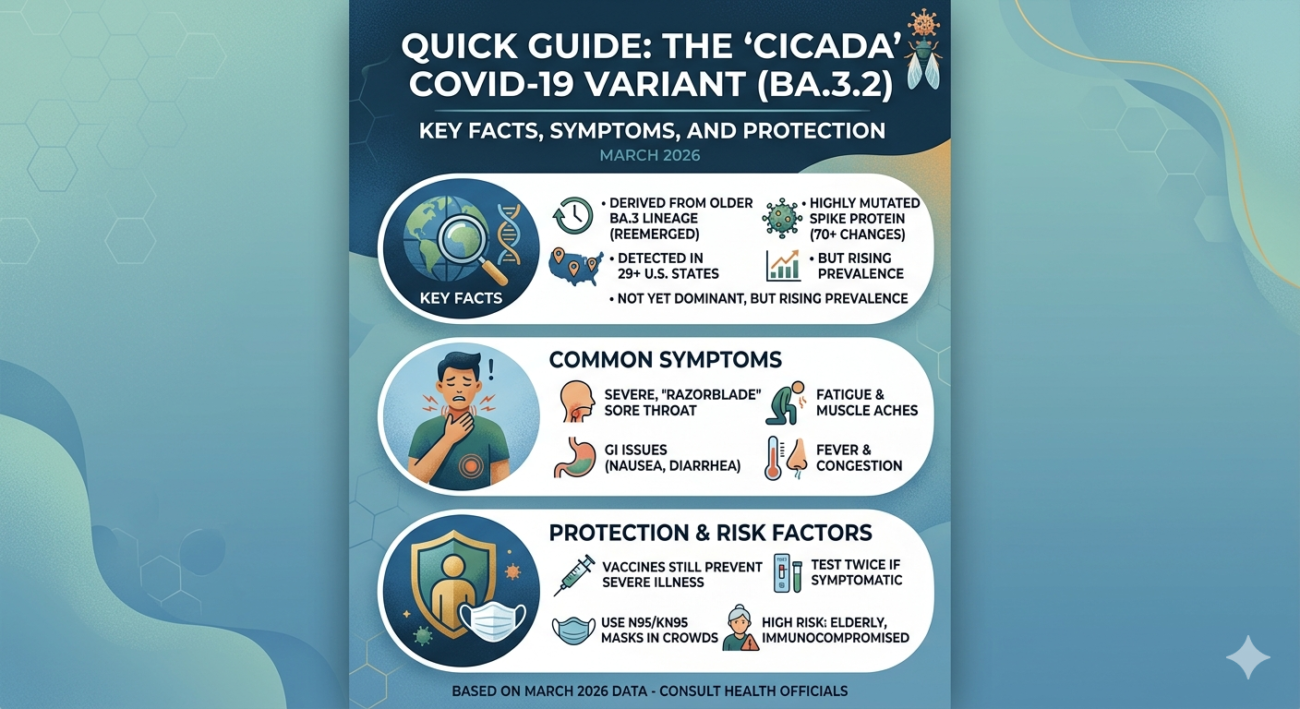
A new COVID-19 subvariant, officially labeled BA.3.2 and nicknamed “Cicada,” is making headlines as it surfaces in the United States and over 20 other countries. While it isn’t currently the dominant strain, its unique genetic “comeback” story has health officials like the CDC and WHO keeping a very close eye on it.
Table of Contents
Why Is It Called “Cicada”?
The name isn’t just a random choice. Like the insect that spends years underground before suddenly emerging, this variant is a descendant of the BA.3 lineage—an older branch of the Omicron family that mostly disappeared in early 2022. After nearly two years of “quiet” evolution, it has resurfaced with a massive number of new mutations.
Key Facts & Mutations
- Highly Mutated: Cicada carries roughly 70–75 mutations in its spike protein. This is significantly more than the recent JN.1 and LP.8.1 strains that current vaccines were designed to target.
- Detection in the U.S.: As of late March 2026, it has been detected in wastewater or clinical samples across 25 states.
- Global Presence: It has been identified in at least 23 countries, including Japan, Germany, and the Netherlands. In parts of Europe, it already accounts for up to 30% of sequenced cases.
- Immune Escape: Because of its high mutation count, lab data suggests it may be better at “dodging” antibodies from previous infections or older vaccines.
What Are the Symptoms?
For the most part, Cicada feels a lot like other Omicron variants, but doctors are noting a few specific trends:
- Severe Sore Throat: This is being reported more frequently with BA.3.2 than with previous subvariants.
- Gastrointestinal Issues: Some patients are reporting nausea or diarrhea more often.
- Classic Symptoms: Fever, persistent cough, fatigue, headache, and congestion remain the most common signs.
- Loss of Taste/Smell: While rare in recent years, it is still occasionally reported.
Risk Factors: Should You Be Worried?
The short answer is: Be aware, but don’t panic.
- No Increased Severity: Currently, there is no evidence that BA.3.2 causes more severe illness or higher rates of hospitalization than previous versions of COVID-19.
- Vaccine Protection: While the variant might be better at causing “breakthrough” infections, experts emphasize that current vaccines and boosters still provide strong protection against severe disease and death.
- Risk Groups: As always, the elderly, immunocompromised individuals, and those with underlying heart or lung conditions remain at the highest risk for complications.
Expert Insight
Virologists describe BA.3.2 as a “variant under monitoring.” While it has the potential to drive a summer surge due to its “immune escape” abilities, it hasn’t yet shown the explosive growth needed to completely overtake other circulating strains.
What exactly is the BA.3.2 “Cicada” variant?
BA.3.2 is a highly mutated subvariant within the Omicron family. It is a direct descendant of the BA.3 lineage that briefly circulated in early 2022. It is genetically distinct from the JN.1 and LP.8.1 strains that dominated 2024 and 2025.
Why is it called “Cicada”?
It was nicknamed by scientists because of its unusual emergence pattern. Like the cicada insect that stays underground for years before suddenly appearing, this lineage was virtually unseen for nearly two years before resurfacing in late 2024 and spreading more widely in early 2026.
Where has it been detected in the U.S.?
As of late March 2026, the CDC has confirmed detections in 29 states and Puerto Rico. While it began as a “traveler-detected” strain at airports like San Francisco International (SFO) and JFK, it is now consistently found in community wastewater samples.

One thought on “The “Cicada” Variant (BA.3.2): What You Need to Know”